
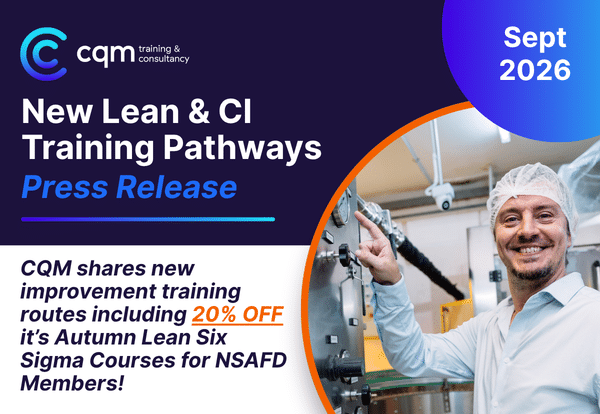
Following the withdrawal of funding for Improvement Practitioner Level 4, National Skills Academy for Food & Drink Industry Approved Provider CQM Training & Consultancy has strengthened its apprenticeship and commercial Lean Six Sigma offer to help food and drink manufacturers continue developing structured improvement capability.
CQM Training & Consultancy has expressed its disappointment at the decision to defund the Improvement Practitioner Level 4 apprenticeship, a programme widely valued by manufacturers as an effective way of developing people capable of leading structured improvement projects and building Lean Six Sigma capability within their organisations.
For CQM, the significance of the change extends beyond the loss of an individual apprenticeship standard.
Improvement Practitioner combined Lean and Six Sigma with project and change management, with apprentices applying that learning to live organisational challenges. That workplace application was particularly valuable to manufacturers because development did not end with gaining a qualification: learners were building the capability to identify problems, analyse evidence, lead projects and repeat that approach against future business challenges.
CQM has seen first-hand how this type of project-led development can generate substantial returns. Its wider analysis of workplace improvement projects found mean annual savings per delegate exceeding £220,000, with apprenticeship projects returning the equivalent of £589 for every hour of learner release. More importantly, the skills remain within the organisation, allowing the value to compound as individuals go on to tackle further problems and support improvement activity around them.
In response to the changes, and following consultation with employers, CQM has strengthened its Business Analyst Level 4 apprenticeship as one of the routes available to organisations looking to retain structured improvement capability.
Business Analyst is not a like-for-like replacement for Improvement Practitioner. Its occupational focus is different, and role suitability remains essential.
There is, however, considerable alignment with the capabilities manufacturers value when trying to understand and shape change. The programme develops skills in business process analysis and modelling, stakeholder engagement, requirements definition, solution evaluation, data-led decision-making and change impact assessment.
Rather than viewing Business Analysis as an IT-only discipline, CQM positions it within the wider improvement lifecycle: helping organisations properly understand a problem or opportunity, establish the current state, engage the people affected, evaluate potential options and build a more robust case for change before implementation.
Within CQM’s wider portfolio, this creates a connected route alongside Improvement Technician Level 3 and Improvement Specialist Level 5, giving employers options for developing improvement capability at different levels of complexity and responsibility. CQM first outlined this strengthened pathway following the announcement of the funding changes earlier this year.
For employers that particularly valued the Lean Six Sigma element of Improvement Practitioner, CQM is also offering those joining its Business Analyst Level 4 programme the opportunity to achieve a Lean Six Sigma Green Belt accreditation upgrade at no additional cost.
For some employers, the priority will not be another apprenticeship at all.
CQM has therefore introduced accessible open-cohort Lean Six Sigma programmes, providing Yellow, Green and Black Belt development for individual delegates and smaller groups that may not have sufficient numbers for a dedicated company cohort.
The Green Belt programme provides a particularly direct alternative for organisations that previously used Improvement Practitioner primarily as a route to building Lean Six Sigma capability.
Delivered live online, the current open programme consists of eight days split into four two-day blocks and leads to accredited Lean Six Sigma Green Belt recognition. Delegates move from the Yellow Belt foundations into more advanced approaches to data analysis, root-cause investigation, process improvement and control, with learning designed around application to real workplace challenges.
CQM’s Autumn 2026 Green Belt open cohort runs from 15th October to 13th November, making it possible to develop accredited Green Belt capability in around a month. Optional coaching can also be added for organisations that want additional support applying the learning to workplace projects, and to gain full accreditation over and above foundational knowledge.
Andrew Cheshire, Managing Director at CQM Training & Consultancy, said:
“We are genuinely disappointed to see Improvement Practitioner lose government funding because we have seen what it can do when it is used well. It gave people much more than a certificate; it gave them a structured way of tackling real business problems, and employers saw the benefit through the projects they delivered.
The project completed during a programme is only part of the return. The bigger opportunity comes afterwards, when somebody has the confidence and capability to apply those methods to the next problem, and then the next one. That is where improvement capability starts to compound.
There isn’t one replacement that will be right for every employer. Business Analyst Level 4 is a natural fit within our wider improvement offering where the role aligns, particularly for people who need to investigate problems, understand processes and stakeholders and shape effective change. Where the real requirement is simply to build Lean Six Sigma capability quickly, our Green Belt programme gives employers a much shorter and more accessible route.”
To support food and drink manufacturers considering their next steps, CQM is offering 20% off its open commercial programmes this Autumn exclusively for NSAFD members.
Members can use the promotional code NSAFD20 at checkout when booking through CQM’s learning platform. The offer can be used across eligible open commercial programmes, including CQM’s Lean Six Sigma Yellow and Green Belt provision.
CQM’s broader approach combines apprenticeships and commercial development rather than treating them as competing options, enabling employers to build pathways appropriate to different roles and levels across their workforce.
Its food and drink capability portfolio spans leadership, Lean Six Sigma, continuous improvement and technical development including the Food Industry Technologist Level 3 apprenticeship. You can take a look at how CQM can support your business with its dedicated Building Capability in Food & Drink Manufacturing Guide.
Employers can explore CQM’s Business Analyst Level 4 apprenticeship, its Lean Six Sigma open programmes or the full range of courses available through its learning platform to identify the development route that best fits their people and improvement priorities.
Simply enter your details to request a copy of the T Level Toolkit for Employers in the Food & Drink Sector.
"*" indicates required fields
Simply enter your details to request a copy of the Skills Insight and Labour Market Focus.
"*" indicates required fields

